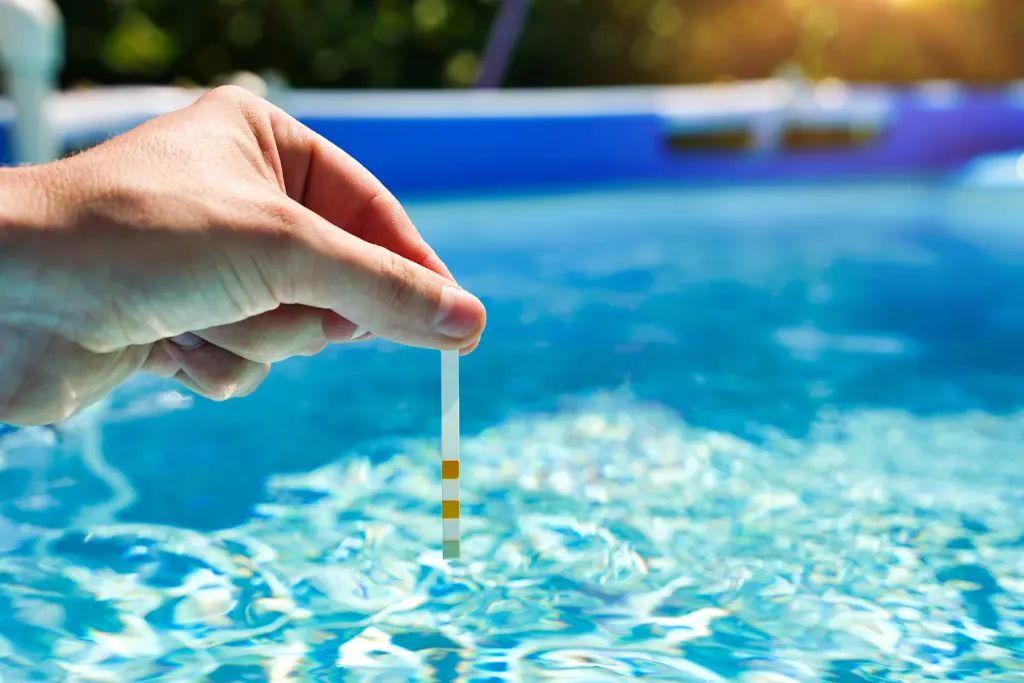
If you've ever spent a weekend adjusting your pool chemicals, checked every reading, felt confident everything was finally right — and then tested again three days later to find it all off again — you're not imagining things. Keeping pool water balanced in the Dallas-Fort Worth area is genuinely more challenging than in most other parts of the country.
It's not bad luck. It's chemistry — and it's specific to North Texas conditions. Here's why water balance is so difficult in DFW and exactly what it takes to get it right.
Three things make pool water chemistry particularly challenging in North Texas — extreme heat, intense UV exposure, and hard water.
DFW summers regularly push past 100 degrees. Heat accelerates every chemical reaction in your pool. Chlorine depletes faster. Algae grows quicker. pH drifts more rapidly. A pool that might stay in balance for five or six days in a milder climate can swing out of range in DFW in two to three days during peak summer heat.
UV exposure compounds the problem. Texas sun is intense for most of the year and UV light is chlorine's biggest enemy — it destroys free chlorine rapidly in pools without adequate stabilizer. Even with proper CYA levels, chlorine consumption in a DFW summer is significantly higher than national averages account for.
Hard water is the third factor. DFW tap water is calcium-rich due to the limestone geology across North Texas. Every time you top off your pool with local tap water you're adding more calcium and minerals to an already concentrated system. Managing calcium hardness, scaling, and total dissolved solids is an ongoing challenge that most generic pool care advice simply doesn't address adequately.
Free Chlorine — 1 to 3 ppmYour primary sanitizer. In DFW heat it burns off fast — test at minimum twice a week in summer and adjust immediately when levels drop below 1 ppm. Never let free chlorine hit zero. Even a few hours without adequate sanitizer in peak summer heat is enough for algae to gain a foothold.
pH — 7.2 to 7.6pH affects everything. High pH reduces chlorine effectiveness and accelerates scale formation — especially problematic in DFW where water already trends alkaline. Low pH corrodes surfaces and equipment and irritates swimmers. Test pH every time you test chlorine and treat it as equally important.
Total Alkalinity — 80 to 120 ppmAlkalinity stabilizes pH. Without it in the right range pH swings wildly with every chemical addition or rainfall. Always adjust alkalinity before pH when balancing your water — getting alkalinity stable first makes pH management significantly easier.
Cyanuric Acid — below 50 ppm for chlorine poolsCYA protects chlorine from UV degradation but too much makes chlorine unable to sanitize effectively. In DFW where stabilized chlorine products are commonly used, CYA climbs faster than many homeowners realize. Test quarterly and do a partial drain if it exceeds 70 to 80 ppm.
Calcium Hardness — 200 to 400 ppmDFW water pushes calcium hardness toward the high end of this range consistently. Above 400 ppm scale deposits form on tile, plaster, and inside equipment. Monitor monthly and use a scale inhibitor regularly to keep calcium in solution rather than depositing on surfaces.
Treating symptoms instead of causes — Adding chemical after chemical to fix cloudy water or persistent algae without identifying the underlying imbalance is the most common and costly mistake. Cloudy water despite adequate chlorine usually points to high pH, high calcium, or a filter that isn't working properly — not a need for more chlorine.
Testing too infrequently — Once a week testing is not enough in a DFW summer. Chemistry shifts too fast. Twice a week at minimum, more during heat waves or heavy use periods.
Ignoring CYA until it's a crisis — CYA creeps up slowly and silently until your chlorine stops working and you can't figure out why. Test CYA at least quarterly and track the trend over time.
Adding chemicals without knowing your pool volume — Every chemical dosage recommendation is based on pool volume. Dosing a 15,000 gallon pool as if it's 25,000 gallons — or vice versa — leads to chronic imbalance. Know your exact pool volume and use it for every treatment calculation.
Skipping alkalinity adjustment — Many homeowners go straight to pH when water is out of balance. Adjusting pH without stabilizing alkalinity first leads to pH bounce — it corrects temporarily then drifts right back out of range within days.
The reason DFW homeowners who hire professional weekly pool service report dramatically fewer water problems isn't magic — it's consistency. A professional technician tests your water with calibrated equipment every single week, makes precise adjustments based on your specific pool's chemistry, and catches trends before they become problems.
There's no guessing on dosage. No skipped weeks because life got busy. No treating symptoms without understanding causes. Just accurate, consistent water chemistry management week after week regardless of what the Texas weather throws at your pool.
At Bluewater Pool Care every weekly service visit includes full water chemistry testing and balancing across all key parameters. You get a detailed service report after every visit showing exactly where your water stands and what was adjusted — complete transparency every single week.

If your pool water feels like a constant battle you can never quite win, the problem isn't your pool. It's the consistency and precision of the maintenance it's receiving. Bluewater Pool Care provides expert weekly pool service across the Dallas-Fort Worth area built specifically around the demands of North Texas water chemistry.
Get a Free Estimate and let us take water balance completely off your plate.