Most DFW homeowners don't think much about their water source when it comes to pool care, but the hard water common throughout North Texas creates a slow, ongoing challenge that affects nearly every pool in the region. Left unaddressed, calcium scale buildup damages surfaces, reduces equipment efficiency, and creates cosmetic issues that get progressively harder to reverse the longer they're ignored.
Why DFW Water Is Particularly Hard
The water supply across much of the Dallas-Fort Worth area carries a high mineral content, particularly calcium and magnesium, compared to many other regions. Every time a pool is filled or topped off, this mineral-rich water introduces more calcium into the system, and without proper balancing, that calcium doesn't stay dissolved in the water indefinitely.
How Calcium Scale Actually Forms
When calcium levels exceed what the water can hold in solution, especially in combination with high pH or high alkalinity, calcium begins precipitating out of the water and depositing onto surfaces. This shows up as a chalky, white, or grayish crust on tile lines, plaster surfaces, and equipment components that come into contact with pool water.
Once this scale forms, it doesn't simply wash away with normal circulation. It requires physical removal or specific chemical treatment, and if left long enough, it can permanently etch or discolor certain surfaces.
Where Scale Buildup Causes the Most Damage
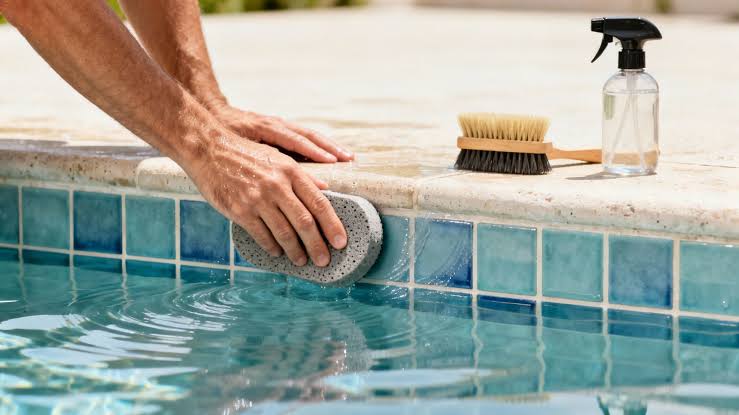
Tile lines are usually the first visible sign of calcium scale, appearing as a rough, white crust along the waterline that's both unsightly and increasingly difficult to remove the longer it's allowed to build. Plaster surfaces can develop a rough, uneven texture as calcium deposits accumulate, which affects both appearance and the smooth feel of the pool surface.
Equipment suffers in less visible but potentially more costly ways. Heater elements, pump components, and salt cell systems (if applicable) can accumulate scale internally, reducing efficiency and eventually leading to premature equipment failure if scale is allowed to build up over multiple seasons.
Balancing Water to Prevent Scale Formation
Preventing calcium scale comes down to maintaining proper balance between calcium hardness, pH, and total alkalinity, often referred to collectively as the pool's saturation index. When these three factors are kept within proper ranges relative to each other, calcium stays dissolved in the water rather than precipitating out onto surfaces.
This isn't a one-time adjustment. Because DFW's water naturally introduces calcium with every top-off, especially during summer when evaporation increases refill frequency, ongoing monitoring and adjustment are necessary to keep the water balanced over time rather than letting scale-forming conditions develop gradually and unnoticed.
Removing Existing Scale Buildup
Once scale has formed, prevention alone won't remove it. Tile lines typically require specific descaling treatments or careful physical scrubbing with appropriate tools that won't damage the tile surface underneath. More significant plaster or equipment scaling may require professional-grade treatment to address safely without causing additional surface damage in the process.
Why This Requires Ongoing Attention, Not a One-Time Fix
Because DFW's water hardness is a constant factor rather than an occasional issue, calcium scale prevention needs to be part of routine, ongoing water care rather than something addressed only when it becomes visibly obvious. By the time scale is visible on tile lines, it's often already affecting less visible areas like equipment internals.
The team at Bluewater Pool Care monitors calcium hardness alongside pH and alkalinity on every visit, addressing the conditions that lead to scale formation before it has a chance to damage your pool's surfaces and equipment.

Noticing white buildup on your tile line? Reach out to Bluewater Pool Care before it gets worse.